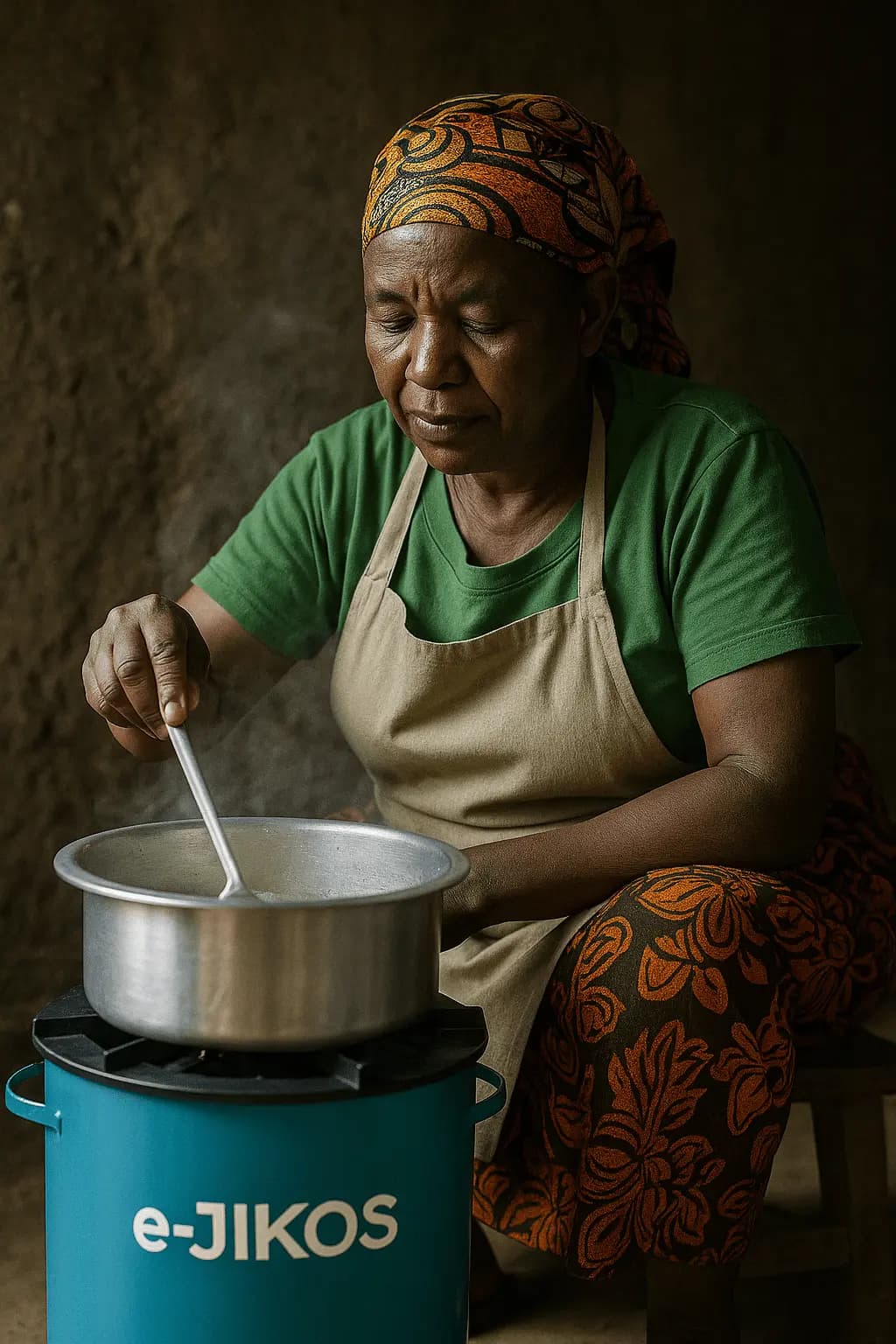
Why Distributing Cookstoves Is Not Enough: Building Credible Monitoring Evidence
Trizer Chepkemboi
Environmental Assessment Analyst
LinkedIn-ready angle: Delivery records, household interviews, fuel tests and sensor data answer different questions. How project and field teams can preserve the evidence needed for a defensible clean-cooking monitoring system.
Delivery records, household interviews, fuel tests and sensor data answer different questions. How project and field teams can preserve the evidence needed for a defensible clean-cooking monitoring system.
A distribution record can establish that a stove was handed over. It cannot, on its own, establish how the household used it, what happened to other cooking devices, or which observations support an emission-reduction estimate. Those are different questions, and a credible monitoring system needs to preserve the distinction.
For field managers, the challenge is practical: can a reviewer follow a reported result back to the household, instrument, observation period and processing decision that produced it? If the answer depends on one staff member remembering what happened, the system needs work.
Why this matters now
The Article 6.4 Supervisory Body adopted two household-cooking methodologies in October 2026 alongside a Sampling and surveys tool and an information note for designated operational entities, the independent organisations responsible for validation and verification. These documents create related but distinct responsibilities for project teams and their assessors. [1]
This article focuses on evidence operations. It is based on the adopted annexes checked on 13 October 2026, and separates source requirements from Supacare's recommended controls. It does not provide a universal questionnaire, sample size or emissions calculator.
Different measurements answer different questions
The Clean Cooking Alliance distinguishes laboratory performance testing from field assessment. A Controlled Cooking Test compares performance using a defined, locally relevant cooking task. A Kitchen Performance Test measures household fuel consumption in everyday conditions, including the household's stove-and-fuel mix. These results should not be treated as interchangeable. [5]
The adopted cooking methodologies add their own requirements for applying measurement and usage evidence. A stove-use monitor is not automatically a substitute for the fuel or energy measurement required by the chosen accounting approach. Likewise, a generic testing protocol cannot override a methodology-specific provision. [3] [4]
Our recommendation is to give every data stream a written purpose. A household interview describes circumstances and responses. A delivery record documents an event. An instrument file records measurements. An analytical dataset contains a processed selection of evidence. Naming these separately makes it harder for an attractive but unsuitable piece of evidence to be used to answer the wrong question.
Supacare's recommended evidence structure
We recommend connecting four types of record rather than placing everything in a single survey form.
- Participant and equipment records identify the household, devices and relevant installation or replacement events.
- Observation records preserve what was collected, when, by whom and through which instrument or interview.
- Processing records explain transformations, exclusions, corrections and the version of the calculation used.
- Review records show who assessed the resulting evidence, what remained unresolved and which release was authorised for reporting.
These records need stable internal identifiers. Replacing a broken sensor should not create a second household, and replacing a stove should not erase the history of the first stove. A file name containing a person's name is a weak substitute for a controlled identifier and is unnecessarily revealing when files are shared.
The system can be simple. What matters is that the same identifier means the same thing in the field form, instrument register and analysis file, and that changes remain traceable.
Protect the sample before the first visit
The Sampling and surveys tool requires a defined population, suitable sampling frame and parameter-specific design. It distinguishes sampling error from other errors, including non-response and measurement problems. The referring methodology takes precedence where its requirements differ. [2]
For field operations, we recommend issuing a controlled visit list linked to the approved selection process. Record unsuccessful visits and the reason for each proposed replacement. A supervisor should be able to distinguish an absent respondent, a refusal, an inaccessible location and a device that is no longer functioning without consulting an informal chat history.
For a household selected because it represents the programme population, quietly choosing an easier neighbour changes more than the day's travel plan. It changes the evidence behind the estimate. Log the difficulty and apply the approved replacement procedure instead of treating the nearest available household as automatically equivalent.
A distance guide may help enumerators navigate or avoid accidental clustering. It does not establish a probability sample. We recommend keeping navigation settings separate from sample-selection rules so that an operational convenience cannot silently become the statistical design.
Check definitions before reusing a spreadsheet
Older tools can look familiar while using different definitions. The 2018 KPT protocol discusses adult-equivalent measures. The adopted UNFCCC cooking documents specify their own household and person-based parameters. Reusing a legacy spreadsheet without checking those definitions can therefore change what a reported number means. [8] [3] [4]
We recommend a parameter register containing the quantity being estimated, its unit, population, time period, source, transformation and acceptance rule. For every imported spreadsheet or software routine, ask which of these definitions it assumes. A correct formula applied to the wrong denominator is still the wrong result.
Keep a small test dataset with known inputs and expected outputs. Use it whenever a formula, form version or processing script changes. This is a software and analytical control, not a replacement for the methodology's statistical requirements.
Treat instruments as part of the evidence
The CCT protocol calls for appropriate measurement resolution, calibration and checks during testing. Its controlled comparisons depend on consistent tasks and documented conditions. [7] A photograph of a scale or sensor cannot establish that the instrument produced reliable measurements throughout a campaign.
Supacare recommends an instrument register connecting equipment identity, deployment dates, checks, faults and repairs to the affected observations. When a check fails, the immediate question should be which records might be affected, not merely whether the instrument works after repair.
For sensors, retain enough information to explain the processing: the relevant configuration, time reference and algorithm version, alongside the raw records. A vendor should be able to demonstrate how an output was produced. A change in software should have a dated record and a documented assessment of its effect, rather than silently rewriting earlier results.
Missing data is a condition to investigate
Consider an illustrative field incident: a sensor stops returning records, the household says it continued cooking, and the enumerator uploads the visit after regaining connectivity. Three events have occurred: a measurement gap, a respondent statement and a delayed transfer. They are not the same event and should not overwrite one another.
Our recommended response is to retain the original files, record the outage interval, investigate whether data remain on the device, and refer the analytical treatment to the applicable rule and technical reviewer. Neither inventing observations nor automatically converting every gap into non-use is a sound general operating policy.
Use separate statuses for collected, transferred, checked and accepted for analysis. A successful upload proves that a file reached the server; it does not prove that its contents are complete, correctly identified or suitable for an emissions calculation.
For offline work, test the entire recovery path before deploying a team: recording without connectivity, restarting the device, restoring access and transferring the same records without duplication. Management should receive an exception list, not just a reassuring total of completed forms.
Make correction history useful
We recommend retaining the original observation and recording each correction separately with its reason, author and time. For an apparent duplicate, preserve the decision explaining which record was retained. For an unusual reading, record the investigation rather than deleting it because it is inconvenient.
Separate automated warnings from final decisions. A weak location reading, unusual timestamp or conflicting answer can justify review; none should automatically become a finding of misconduct. Give supervisors enough context to resolve the issue and leave an auditable explanation.
Daily quality review should focus on unresolved exceptions and recurring causes. If several records fail for the same reason, correcting each form individually may leave the underlying training, instrument or software problem untouched.
Prepare for independent challenge
The information note for designated operational entities separates assessment of a participant's sampling plan from the assessor's own checks. Unresolved discrepancies can prevent affected records from supporting a validation or verification conclusion. An internal completion score is not independent verification. [6]
Before a formal review, we recommend a practical rehearsal. Select a reported result and ask a colleague who did not prepare it to trace it backwards: the calculation version, included observations, excluded records, sampling decision and original evidence. Record where the trail stops or depends on an undocumented explanation.
The handover package should make that exercise possible without giving every reviewer unrestricted access to household personal information. Agree access, responsibilities and the evidence needed for the review. Keep permissions proportionate to the task and obtain appropriate advice on participant information and records handling.
What to bring to an MRV readiness discussion
For an initial conversation with Supacare, provide the selected or proposed methodology, a brief description of the monitoring arrangement, the instruments and software in use, and the main evidence problems the team has encountered. An anonymised example of a record moving from field collection to a reported result is more useful than a large, unexplained file dump.
We can discuss a review covering the evidence structure, field procedures, quality checks and handover arrangements, with a clear scope for any statistical or specialist technical work. Do not send raw household identities, audio or signatures through a general enquiry form.
The purpose is to identify where evidence may be lost, misinterpreted or left unsupported before those weaknesses become costly to resolve. Good monitoring is not the largest possible collection of data. It is a defensible connection between each reported claim and the evidence that can support it.
Scope of this article
The operational controls above are Supacare recommendations, not a substitute for an approved monitoring plan or the applicable UNFCCC requirements. Numerical thresholds, transition provisions, uncertainty treatment and emissions calculations require activity-specific technical review. The article does not certify a project, a field application or an instrument provider.
Share with your network
LinkedIn-ready angle: Delivery records, household interviews, fuel tests and sensor data answer different questions. How project and field teams can preserve the evidence needed for a defensible clean-cooking monitoring system.
Sources & further reading
- 01UNFCCC, SBM 023 report, v01.0: paragraphs 27, 32, 35 and 36 (October 2026)
- 02Sampling and surveys, v01.0: definitions, applicability and sampling design, adopted Annex 20 (9 October 2026)
- 03Cooking energy transitions, v01.0: parameter tables and testing appendices, adopted Annex 9 (9 October 2026)
- 04Energy efficiency measures in household cooking, v01.0: monitoring provisions, adopted Annex 19 (9 October 2026)
- 05Clean Cooking Alliance: purposes of laboratory testing, CCT and KPT (protocol overview, checked 13 October 2026)
- 06Sampling and surveys requirements for designated operational entities, v01.0: paragraphs 17-20 and appendices, approved information note, Annex 21 (9 October 2026)
- 07Controlled Cooking Test protocol, v3.0: measurement equipment and test design (November 2025)
- 08Kitchen Performance Test protocol, v4.0: adult-equivalent definitions (March 2018; supporting context, not a replacement for UNFCCC requirements)
More from Carbon Markets & Policy
October 2026 · 7 min read
UNFCCC's New Cooking Methodologies: What Project Developers Need to Prepare
A practical comparison of the new household-cooking routes, with the actual SUM monitoring dates, the one unresolved cross-reference, and what developers should plan for.
October 2026 · 6 min read
Kenya’s E-Motorcycle Shift Is Real. The Carbon Case Is More Complicated.
VM0038 v1.1 includes two- and three-wheelers and battery swapping in its definitions, while VMD0049 excludes them from its positive list. Here is what developers should establish before committing to a project route.
Work With Us
Speak to the team behind this analysis.