RECH v5.0: The Technical Controls Behind Clean-Cooking Carbon Accounting
Brian Njata
Chief Operations Officer, Supacare Solutions
LinkedIn-ready angle: Gold Standard's new RECH v5.0 methodology makes clean-cooking carbon accounting more conservative. This review explains the technical controls that matter: baseline design, stove stacking, KPT precision, leakage and observation bias.
Gold Standard's new RECH v5.0 methodology makes clean-cooking carbon accounting more conservative. This review explains the technical controls that matter: baseline design, stove stacking, KPT precision, leakage and observation bias.
Gold Standard's Reduced Emissions from Cooking and Heating (RECH) v5.0 is the current Paris Agreement-aligned successor to TPDDTEC. It is a methodology for quantifying eligible emission reductions from decentralised thermal-energy activities. Its importance is not that it turns technology distribution into credits. Its importance is that it creates a chain of technical controls between an intervention and a quantified result.
1. The methodology starts with a clear eligibility boundary
RECH v5.0 applies to technologies and practices that reduce or displace greenhouse-gas emissions from thermal-energy consumption in households and residential, institutional, industrial or commercial facilities. It allows progressive distribution during a crediting period.
The scope is deliberately limited. Metered electric cooking and metered biogas devices are excluded and directed to the Metered & Measured Energy Cooking Devices methodology. Where the claimed change is a practice rather than a new device, the monitoring approach must show that the quantified reduction comes from that practice alone.
This is a sound technical boundary. A method based on field-tested fuel use should not substitute for direct metering where direct metering is available.
2. Technology testing establishes eligibility, not carbon volume
The methodology requires predictable performance, efficiency and durability under field conditions. Biomass-burning models must be tested using ISO 19867-1, an equivalent national standard or the Water Boiling Test protocol. It specifies minimum thermal efficiency thresholds of 20% for wood-burning griddle-surface technologies, 25% for other wood cookstoves and 30% for charcoal cookstoves.
That testing matters, but it does not prove the emission-reduction result. Controlled performance testing establishes that a technology is eligible. The carbon calculation still depends on real-world fuel use, the baseline, usage rates and the other controls in the methodology.
3. The baseline must reflect how people actually cook
The baseline is the conservative estimate of emissions without the activity. RECH v5.0 requires an ex-ante baseline survey and requires the developer to account for every relevant cooking technology and fuel-consumption pattern in the target population. It is not legitimate to compare the new technology only with the least efficient device in a household that uses several.
This matters because stove stacking is normal: households may use several devices for different meals, seasons or fuels. The methodology requires distinct baseline scenarios where fuel use or baseline technologies are materially different.
RECH then applies two formula-driven constraints. Sampling uncertainty must be addressed, and the baseline is reduced using a country- and vintage-specific Downward Adjustment Factor. The final crediting baseline is the lower of the downward-adjusted baseline and conservative business-as-usual emissions.
“A conservative baseline is not a promise to be cautious. Under RECH v5.0, it is a calculation requirement.”
4. Monitoring must capture total fuel use, not just the new device
The Project Kitchen Performance Test, or P-KPT, is central to RECH v5.0. It must capture total relevant fuel consumption across the activity technology and any parallel baseline or other stoves used for the same energy service.
The methodology also requires the P-KPT sampling result to meet a 90% confidence level and 10% margin-of-error target. If the target remains unmet after supplementary sampling, the upper bound of the one-sided 90% confidence interval must be used. This is conservative because it prevents activity emissions from being understated.
KPTs must follow a recognised rigorous protocol, preferably the latest Clean Cooking Alliance protocol or an equivalent standard aligned with ISO 19867-3. The method specifies calibrated scales, calibrated moisture meters for wood, representative fuel conditions and seasonal weighting where testing spans different seasons.
5. Activity emissions and leakage reduce the gross result
Fuel savings are not the final result. RECH v5.0 requires activity emissions unless they are demonstrably negligible or inapplicable. It also requires embodied emissions from device manufacturing and transport, and it requires market and behavioural leakage to be assessed.
The methodology is especially cautious with fossil-fuel activity scenarios. Where fossil fuel is used, eligible reductions are limited to the efficiency-improvement component. The activity fuel's emission factor is used for both baseline and activity calculations, so a fuel-switch narrative cannot be treated as a full avoided-emissions claim under this methodology.
6. The methodology recognises observation bias
Field observation can change behaviour. A household may use a technology more carefully while an enumerator is present than it does in ordinary life. RECH v5.0 addresses this Hawthorne Effect directly in the net-emission-reduction calculation.
For manual monitoring, the methodology applies default adjustment factors of 0.90 for 2026 and 2027, 0.85 for 2028 and 2029, and 0.75 from 2030 onward. Activities can quantify an activity-specific adjustment with representative continuous Stove Use Monitors. Robust continuous monitoring or digital MRV can be exempt where it meets the methodology's representativeness and overlap requirements.
This is one of RECH v5.0's most important integrity features. It treats a known field-measurement risk as an explicit deduction rather than assuming that observed use equals long-term normal use.
What this means for methodology readiness
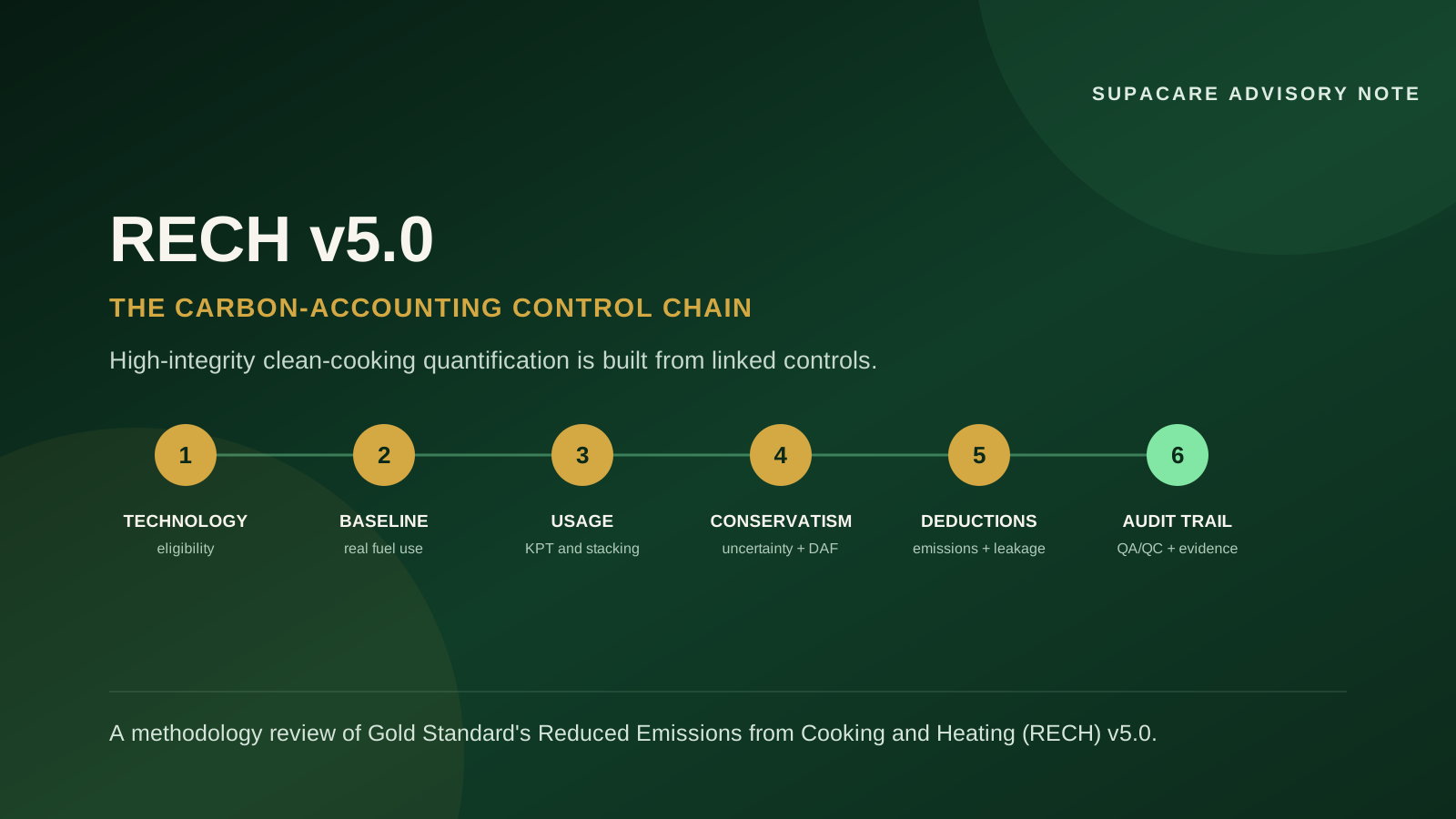
RECH v5.0 is strongest when its controls are read together: tested technology, a measured baseline, total-fuel-use monitoring, uncertainty and ambition adjustments, leakage deductions and an auditable evidence trail.
The critical implementation question is therefore not simply whether a technology is efficient. It is whether the evidence chain is robust enough to support a conservative, reproducible calculation. That requires sound survey design, Kitchen Performance Testing, fuel characterisation, sampling, calibration, QA/QC and transparent data management.
Supacare supports organisations that need to assess methodology fit, design MRV systems and prepare carbon activities for independent review. A methodology-readiness assessment should come before carbon-volume projections or financing decisions.
Share with your network
LinkedIn-ready angle: Gold Standard's new RECH v5.0 methodology makes clean-cooking carbon accounting more conservative. This review explains the technical controls that matter: baseline design, stove stacking, KPT precision, leakage and observation bias.
Sources & further reading
More from Carbon Markets & Policy
October 2026 · 8 min read
Why Distributing Cookstoves Is Not Enough: Building Credible Monitoring Evidence
Delivery records, household interviews, fuel tests and sensor data answer different questions. How project and field teams can preserve the evidence needed for a defensible clean-cooking monitoring system.
October 2026 · 7 min read
UNFCCC's New Cooking Methodologies: What Project Developers Need to Prepare
A practical comparison of the new household-cooking routes, with the actual SUM monitoring dates, the one unresolved cross-reference, and what developers should plan for.
Work With Us
Speak to the team behind this analysis.